
Best Google SEO Updates 2026: The Ultimate Guide Every Website Owner Needs
If you’ve been keeping an eye on search rankings lately, you’ve probably noticed things moving fast. The Google SEO updates 2026 rollout has been one of the busiest — and most exciting — in years, touching everything from core ranking signals to how AI Overviews display content. This post breaks down the essential Google SEO updates 2026 so far, what they mean for your site, and how to adjust your strategy before the next wave hits.
Why the Google SEO Updates 2026 Matter
Every year, Google refines how it ranks and displays content — but the Google SEO updates 2026 cycle has been different. Instead of one dramatic algorithm shake-up, Google has been shipping smaller, continuous changes: spam updates, AI feature rollouts, and Search Console improvements. Taken together, these Google SEO updates 2026 changes are reshaping what “ranking well” even means.
Key Algorithm Changes
The biggest confirmed move in the Google SEO updates 2026 timeline was the June spam update, which rolled out in just two days but hit hard. There’s also been unconfirmed ranking volatility in mid-July, with early signs pointing to weak E-E-A-T signals, thin templated pages, and poor Core Web Vitals as common causes of drops. Based on Google’s established cadence, the next broad core update is expected in August or September.
AI Overviews and Search Experience Updates
A major theme running through the Google SEO updates 2026 announcements is how much AI is reshaping the results page itself:
- AI Overviews now include a live news carousel, AI-generated images, and new citation displays.
- Google rolled out an “Intelligent Search box” powered by Gemini, supporting multimodal queries and smarter query expansion.
- Google is showing more outbound links inside AI Overviews and AI Mode — good news for publishers who were worried about traffic loss.
- “Search Live” now lets users have voice conversations with Search and share their camera feed for real-time answers.
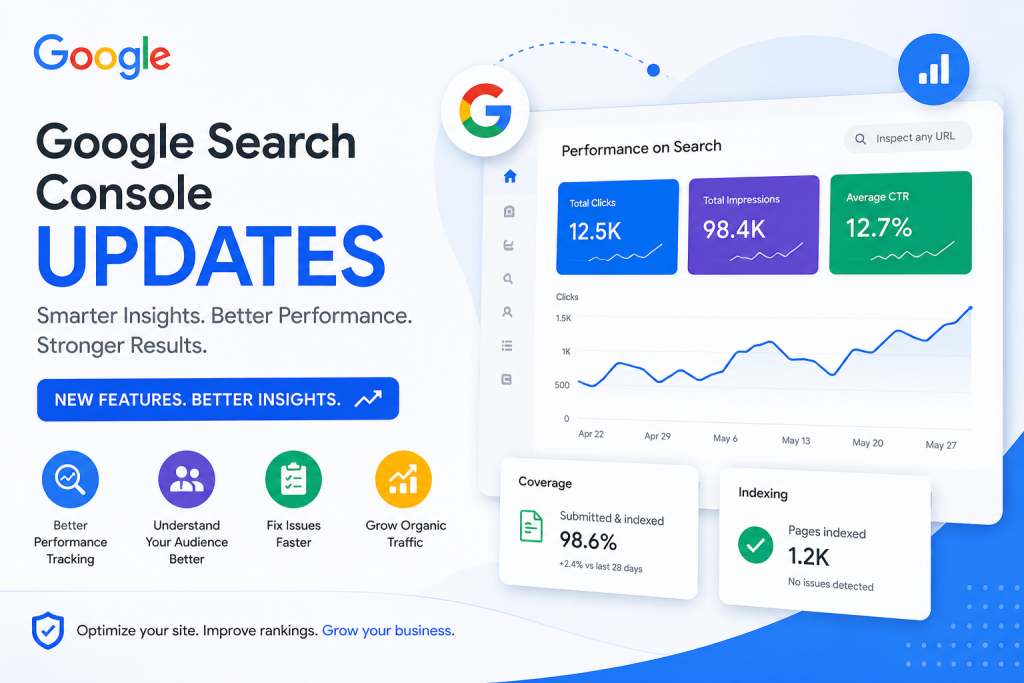
Google Search Console: What’s New
Search Console has picked up several meaningful updates as part of the Google SEO updates 2026 rollout, and a few of them change how site owners should think about tracking performance day to day:
- Platform Properties is now fully live. This is one of the bigger changes in Search Console’s history — you’re no longer limited to tracking a verified website.
- A long-standing bug in the Links report has finally been fixed, giving more reliable internal and external link data.
- The Page Indexing report has been delayed again, continuing a reporting-lag pattern seen through much of the year — don’t panic if your numbers look stale.
- Google clarified that LLMs.txt files currently neither help nor hurt rankings — HTML remains the standard format for SEO, not Markdown.
- Google confirmed it will not publish a defined order of precedence for conflicting metadata signals (for example, a redirect pointing one way while a canonical tag points the other). If your signals conflict, clean them up rather than guessing which one Google will trust.
Search Console Meets Social Media: The Platform Properties Update
The single most talked-about piece of the Google SEO updates 2026 cycle for content creators is how Search Console now connects directly to social media. Here’s how it works and why it matters:
- What it is. Platform Properties is a new property type in Search Console that reports on how your content performs in Google Search and Discover — even if that content lives entirely on a social or video platform, not your website.
- Which platforms are supported. You can now connect Instagram, TikTok, X, and YouTube accounts directly to Search Console.
- What you can see. Once connected, you get clicks, impressions, and a breakdown of your best-performing posts — the same kind of data you’d normally only get for a verified website.
- Why this matters. If you run a business account on Instagram or TikTok, your content has likely always been showing up in Google search results without you realizing it. Now you can actually measure that visibility instead of guessing.
- No website required. This is a genuine shift — creators and small businesses without a website can now get real search performance data for the first time.
For anyone building a brand across both a blog and social channels, this update means your Google SEO updates 2026 strategy shouldn’t stop at your website. Treat your Instagram, TikTok, X, and YouTube content as searchable assets, and check Search Console regularly to see which posts Google is actually surfacing.
What To Do About the Google SEO Updates 2026
You don’t need to panic every time a new headline drops. Here’s a practical checklist for adapting to the Google SEO updates 2026 environment:
- Audit for E-E-A-T signals. Make sure content shows real authorship, first-hand experience, and clear expertise.
- Check Core Web Vitals. Page speed and stability still matter, especially during volatility windows.
- Add structured data. Product, Review, and FAQ schema are paying off disproportionately as AI features expand.
- Connect your social platforms in Search Console using the new Platform Properties tool, and start tracking how your Instagram, TikTok, X, or YouTube content performs in search.
- Clean up conflicting metadata. Since Google won’t say which signal wins in a conflict, make sure your redirects, canonicals, and other tags all agree with each other.
- Prioritize revenue pages — homepage, service pages, and pricing — over publishing volume alone.
Final Thoughts
The pace of the Google SEO updates 2026 rollout shows no signs of slowing down. Between AI Overviews, Search Console’s new social media integration, and ongoing algorithm refinements, staying visible in search now means managing your presence across AI surfaces and social platforms — not just chasing blue-link rankings. Keep an eye on this space, and revisit your strategy every time a new update lands.
Sources: Search Engine Roundtable, Search Engine Land, Numinix, SE Ranking, Position Digital (July 2026).